🎯
Question & protocol
Define your research question and PICO framework, and pre-register inclusion/exclusion criteria before screening begins.
EVIDENCE SYNTHESIS SOFTWARE
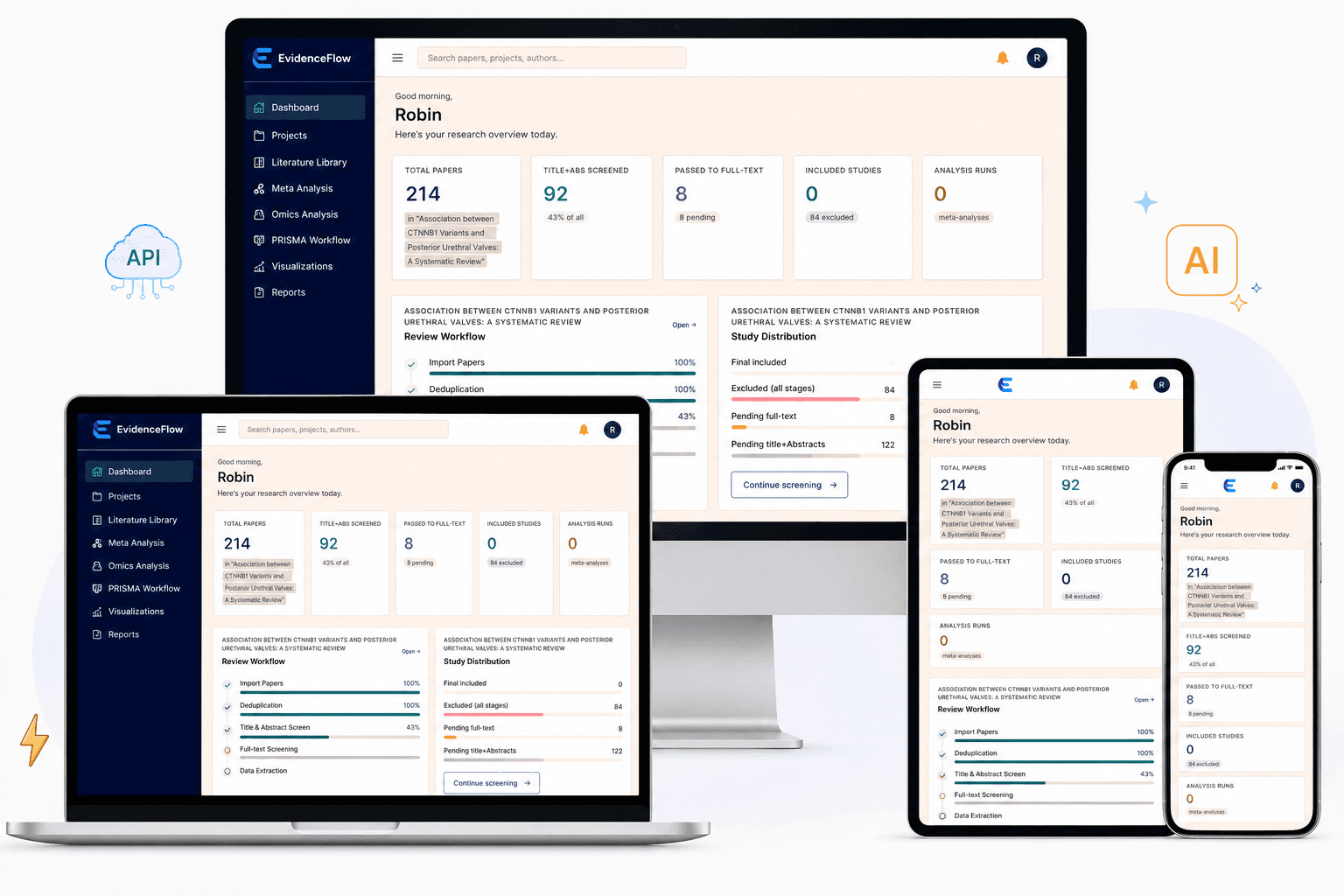
EvidenceFlow is an evidence operating system, not a single-purpose tool — literature, extraction, statistical analysis, and the scientific claims that follow from them, connected in one reproducible workflow across clinical and omics research.
Clinical + Omics
Research domains
8
Workflow stages
Traceable
Every decision
Define your research question and PICO framework, and pre-register inclusion/exclusion criteria before screening begins.
Import from PubMed, RIS, BibTeX, or CSV, with automatic deduplication before any reviewer sees a duplicate record.
AI-assisted title/abstract and full-text screening with blind dual review and disagreement detection.
Structured clinical and omics extraction forms, with AI auto-fill you review and edit.
Pool effect sizes with fixed or random-effects models, or aggregate GWAS variants and RNA-seq gene-level results — the same platform, either research domain.
Every screening decision, extracted value, and pooled estimate stays linked to its source, then exports as a PRISMA 2020 diagram, PDF/Word report, or JSON data package.
Systematic reviews are one kind of evidence synthesis — meta-analysis of clinical trials and aggregation of omics data are others. EvidenceFlow treats them as the same underlying workflow: literature in, structured data extracted, analysis pooled, claim published, with the same traceability throughout.
See the meta-analysis engine in detail →Related capabilities
The screening, extraction, and PRISMA-tracking workflow this platform is built around.
The statistical engine — fixed/random effects, Mantel-Haenszel, Peto, forest plots — built to Cochrane conventions.
How AI-assisted relevance scoring speeds up screening without taking the final decision away from reviewers.
How this evidence pipeline extends to GWAS, RNA-seq, and rare-variant genomics literature.
FAQ
Software that connects the stages of turning published literature into a defensible scientific conclusion — screening, data extraction, statistical pooling, and reporting — rather than handling only one stage in isolation.
Yes — GWAS variant aggregation and weighted gene-level RNA-seq synthesis are built in alongside clinical systematic review and meta-analysis workflows.
Every screening decision records who made it and when; every extracted value can be traced back to the study it came from; every pooled estimate can be traced back to the extraction records that fed it — nothing is a black-box output.
Systematic reviews are the most common use case, but the same workflow handles omics meta-analysis and mixed-methods evidence synthesis without switching tools.
The core workflow — literature import, screening, extraction, statistical pooling, and reporting — is free, with your data exportable as CSV, JSON, or PDF at any time. AI-assisted screening, extraction, and manuscript drafting are a paid upgrade.
Start a project and see literature, extraction, analysis, and reporting working as one traceable pipeline — free to start, no credit card.