📚
Literature Screening
Conduct title, abstract, and full-text screening using a Rayyan-inspired workflow with conflict resolution and multi-reviewer collaboration.
FREE CORE PLATFORM
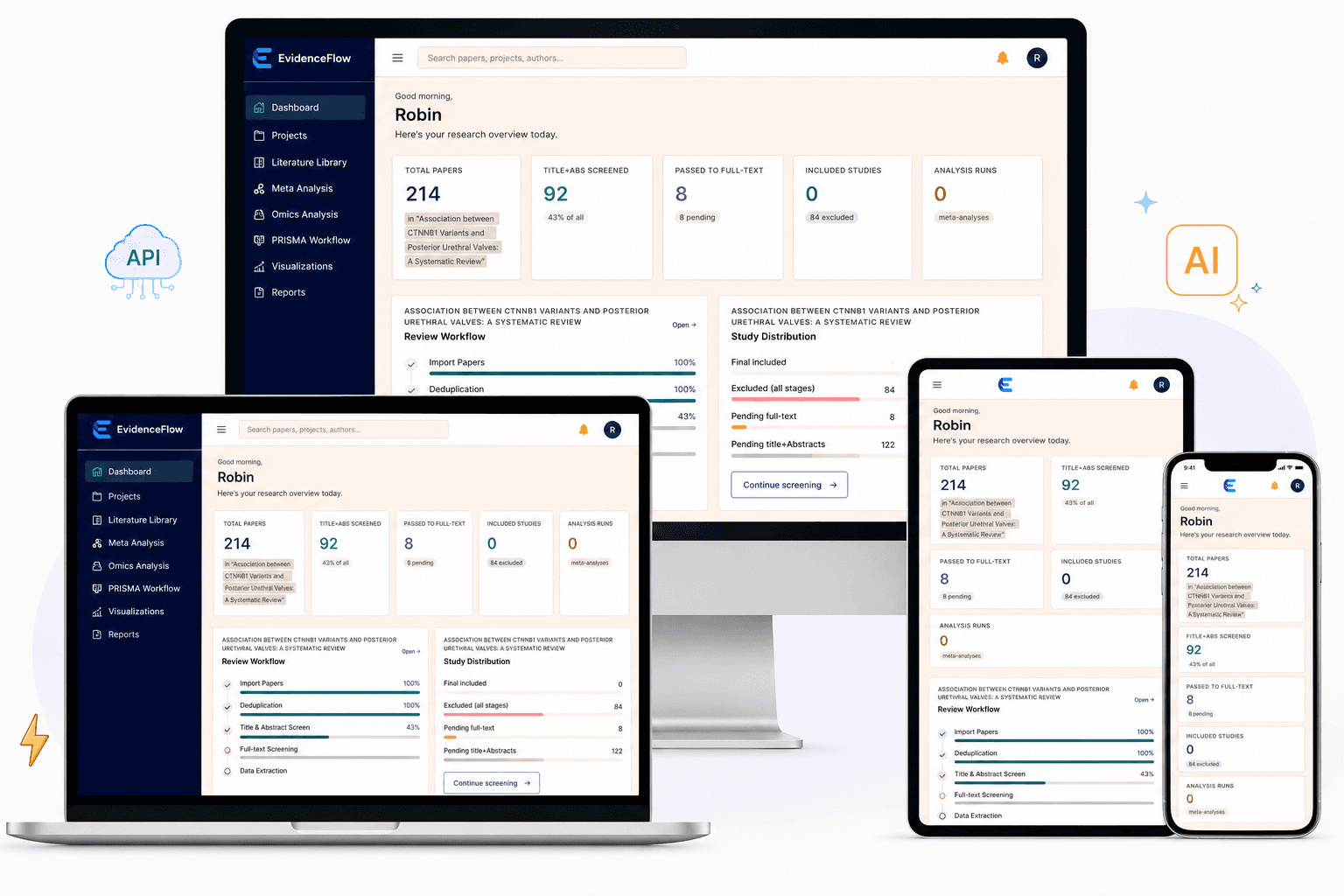
EvidenceFlow is an evidence operating system for systematic reviews, meta-analysis, and omics research-connecting literature, extraction, analysis, and scientific claims in one reproducible workflow.
3
Review Stages
10+
Statistical Analyses
PRISMA
2020 Ready
Hover a stage for a quick look, or click to read more. Evidence to claim, one reproducible pipeline.
Step 1 of 8
Define your research question and PICO framework. Every decision downstream — screening, extraction, synthesis — traces back to this starting point.
Define your research question and PICO framework. Every decision downstream — screening, extraction, synthesis — traces back to this starting point.
Blind dual review, automatic disagreement detection, and a full audit trail — every decision accountable, every reviewer's progress visible.
Live progress
Configurable
Title & Abstract
Full Text
Conflict resolution
Integrates with the sources and standards you already use
From import to publication-ready output in one platform - no stitching tools together.
Conduct title, abstract, and full-text screening using a Rayyan-inspired workflow with conflict resolution and multi-reviewer collaboration.
Pool effect sizes and quantify heterogeneity in minutes, using fixed and random effects models with publication-ready forest and funnel plots.
Synthesize evidence across populations and studies with GWAS variant aggregation, weighted gene-level RNA-seq summaries, and chromosome-level Manhattan plots.
Cut screening time by surfacing the most relevant studies first, with AI-powered relevance scoring against your research question.
Stay reporting-compliant with zero manual bookkeeping, using automated PRISMA flow diagrams that track counts at every stage.
Keep review teams in sync with role-based access, dual-reviewer screening, conflict detection, and a full audit trail.
Every screen is designed around real systematic review workflows.
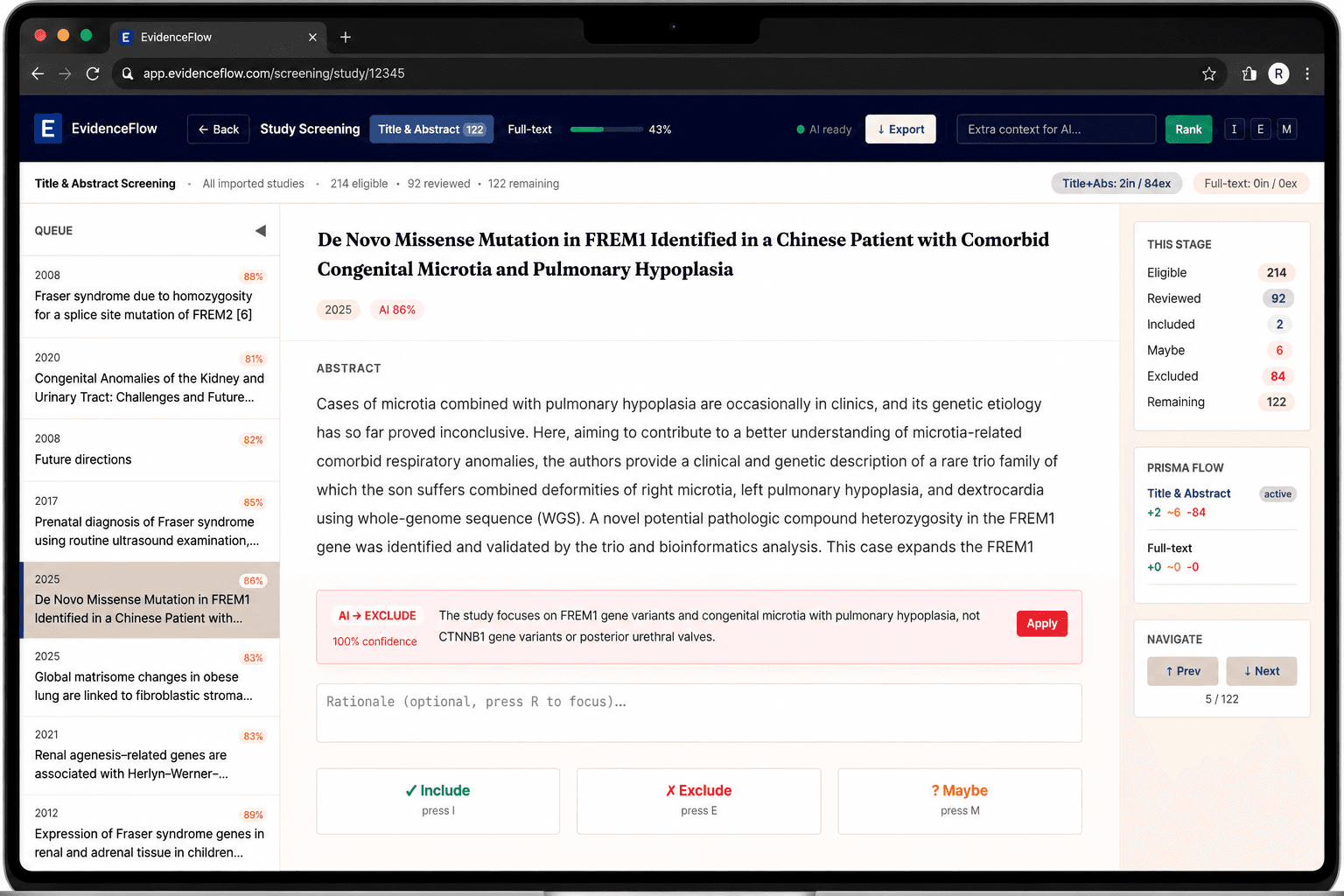
Rayyan-style abstract viewer with AI relevance scores, include/exclude controls, conflict detection, and stage-by-stage progress.
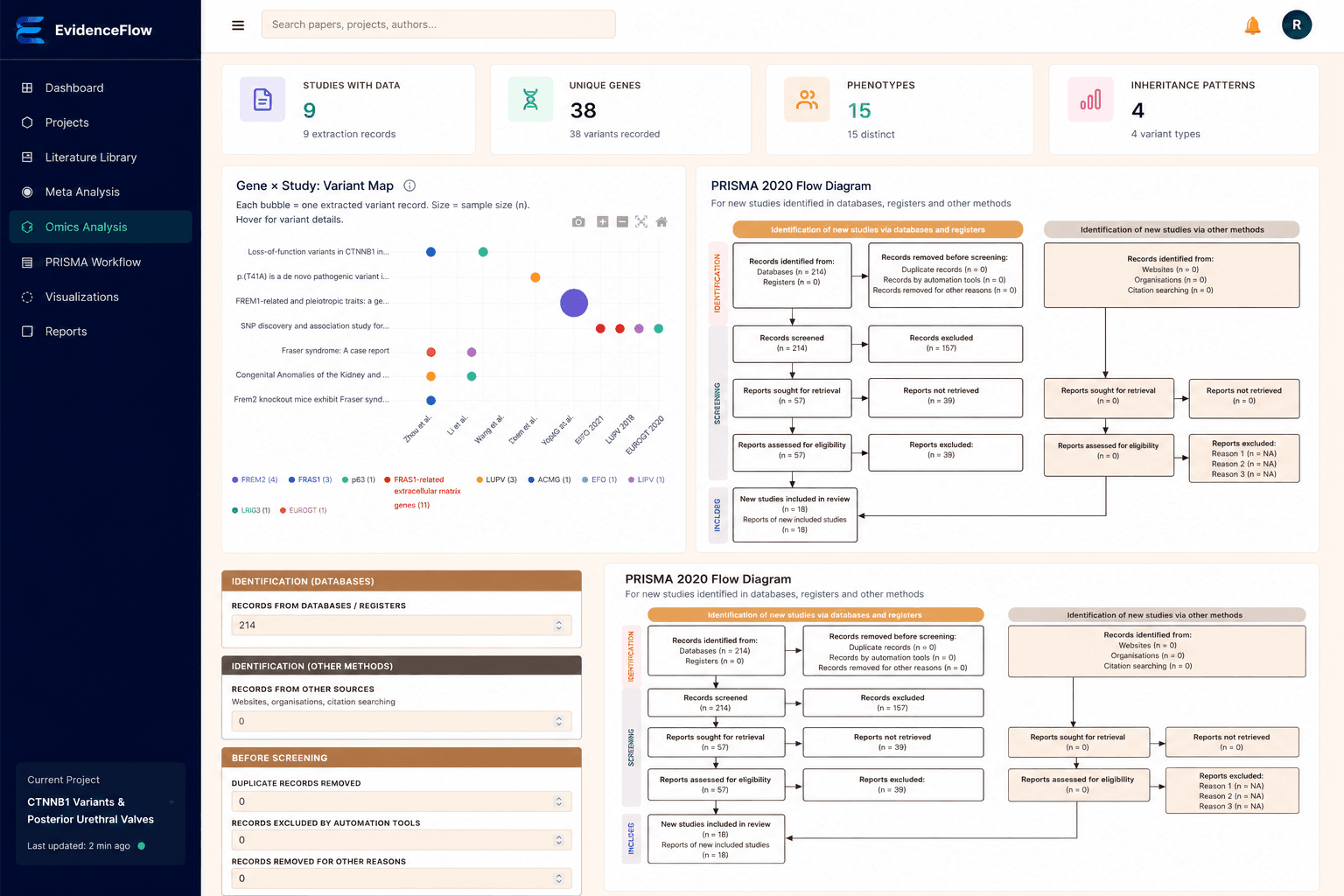
Forest plots, funnel plots, PRISMA flow diagrams, and omics Manhattan plots - all generated from your extracted study data.
Whether you’re running a single review or coordinating a department, EvidenceFlow fits the workflow.
Conduct PRISMA-compliant systematic reviews without switching between screening, extraction, and reporting tools.
Integrate GWAS, RNA-seq, and genomic datasets into your evidence synthesis alongside clinical literature.
Complete dissertations and evidence syntheses faster with AI-assisted screening and structured data extraction.
Run collaborative evidence reviews across departments with role-based access and a shared audit trail.
EvidenceFlow is free and transparent - because good research infrastructure should be shared, not siloed.
All statistical methods are documented and auditable. Reproducible analyses with full parameter history.
Read the docsExport full data packages JSON, PDFs, and plots so every review step can be independently verified.
Learn moreYour data is never locked in. Every project exports as CSV, JSON, and PDF, ready for reuse elsewhere.
See export optionsImport from PubMed, RIS, and BibTeX, and generate PRISMA 2020-compliant flow diagrams out of the box.
View standardsFAQ
EvidenceFlow is an AI-assisted evidence synthesis platform for systematic reviews, meta-analysis, and omics research. It streamlines literature screening, structured data extraction, PRISMA 2020 reporting, and statistical analysis for researchers, clinicians, and bioinformaticians.
The core platform is free — literature import, manual screening, extraction, meta-analysis, and PRISMA reporting, with no subscription or seat limits. AI-assisted screening, extraction auto-fill, and manuscript drafting are a paid upgrade.
EvidenceFlow uses AI to prioritize studies based on your research question, PICO framework, and inclusion/exclusion criteria. Each study receives a suggested decision, confidence score, and explanation, while final screening decisions always remain under researcher control.
EvidenceFlow combines collaborative literature screening, PRISMA workflow management, statistical analysis, and AI-assisted evidence synthesis within a single platform, reducing the need to switch between multiple research tools.
Yes. EvidenceFlow automatically tracks study counts throughout the review process and generates PRISMA 2020-compliant flow diagrams that can be exported with your reports.
EvidenceFlow supports RIS, BibTeX, CSV, and direct PubMed search import, and you can upload full-text PDFs directly for full-text screening — making it easy to start new systematic review projects from existing reference libraries.
No, EvidenceFlow's source is not publicly available, and its application code is released under the MIT License. The core platform is free to use; AI-assisted features are a paid upgrade. Your data remains portable through CSV, JSON, and PDF exports either way, so you're never locked into the platform.
Yes. EvidenceFlow supports multi-reviewer projects with role-based access, dual-reviewer screening, conflict detection, and an audit trail of every decision.
EvidenceFlow's meta-analysis engine supports both fixed-effect and random-effects (DerSimonian–Laird) pooling, with heterogeneity statistics including Cochran's Q, I², and Tau², visualized as forest and funnel plots.
Yes. PRISMA 2020 flow diagrams are generated automatically from your screening decisions and can be exported as part of your PDF or Word report.
Yes. Export your review at any stage as PDF, Word, CSV, JSON, or PRISMA 2020 flow diagrams for sharing, publication, or further analysis.
Yes. Your projects remain private to your workspace unless you explicitly invite collaborators to join them.
EvidenceFlow is designed for researchers, clinicians, students, systematic review teams, and bioinformaticians conducting evidence synthesis across clinical and omics research.
Yes. EvidenceFlow includes workflows for aggregating GWAS variants, gene expression (RNA-seq) results, and other omics data alongside traditional systematic reviews.
Create a free account, import your references, and start screening with no configuration needed. AI-assisted screening, extraction, and manuscript drafting are available as a paid upgrade.